
stateless spaces ep.01: builders and storytellers
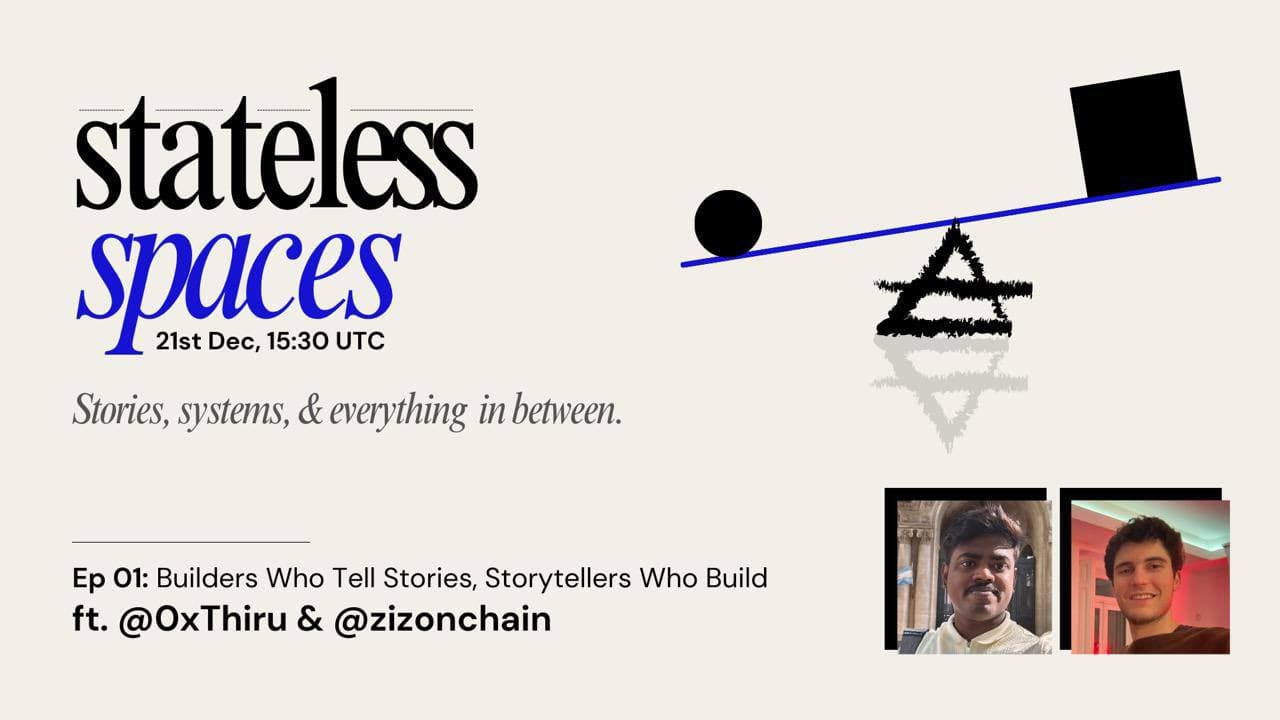
what happens when builders learn to tell stories, and storytellers learn to build?
stateless spaces is a hallway track of the internet.
episode one brought together two complementary perspectives:
- @0xThiru, a builder who has lived through the pain of shipping good products that nobody noticed
- @zizonchain, a storyteller-builder who thinks deeply about narrative, identity, and why belief scales faster than code
the goal was simple: to explore whether storytelling has become a necessary skill for builders, and what kind of storytelling actually matters.
setting the frame
as host, i framed the session around a few uncomfortable ideas:
- shipping is invisible until you narrate it
- storytelling is operational clarity turned outward
these weren’t meant as slogans. they were meant as pressure points.
the real question underneath all of them was this: in a world where building is getting cheaper and faster, what actually compounds?
the builder’s perspective: @0xThiru
coming from a deep engineering background, @0xThiru was explicit about where most builders go wrong.
he described a familiar arc: shipping hackathon projects, building solid infrastructure, even winning grants, but never quite reaching real users or sustained adoption.
not because the tech was bad. because distribution was missing.
the lesson was sharp:
builders don’t fail because they can’t build. they fail because they explain what they built instead of why it matters.
thiru also pointed out something important about the current moment: the barrier to building is collapsing fast. tools, frameworks, and ai make shipping easier than ever.
which means building alone is no longer enough.
the storyteller’s perspective: @zizonchain
@zizonchain took the conversation deeper, stepping back from products entirely and into how humans make sense of the world.
his core argument was simple but unsettling:
if you think storytelling is marketing, you are already late.
storytelling predates technology. it predates institutions. it predates products.
religion, nations, movements, and money exist because people believed shared stories before they trusted systems.
founders forget this.
they assume markets are rational. they assume people choose based on utility.
but markets are driven by desire before logic, and identity before features.
@zizonchain broke this down as the difference between:
- physical value: what a product does for you
- metaphysical value: what using it says about you
most builders only ship the physical layer.
what lasts is the metaphysical layer.
that’s why people don’t just buy tools. they buy into movements, identities, and worldviews.
and that’s also why storytelling is such a strong moat: ai can replicate features, but it cannot replicate belief.
creators, builders, and the coming reset
from thiru’s angle, a lot of creator content is shallow, keyword-heavy, and surface-level. exactly the kind of work ai excels at.
what survives:
- deep understanding
- technical fluency
- the ability to explain complexity without hiding behind jargon
from zizon’s angle, the bar for storytelling isn’t lowering. it’s rising. future storytellers will need taste, context, and conviction, not just reach.
the synthesis was clear: builders need narrative, and creators need substance.
activations: what to do after this
we closed the session with concrete actions.
from @0xThiru: document the journey
for builders especially, documenting what you build is not about clout. it’s about creating surface area for opportunity.
most good things don’t come from polished announcements. they come from visible momentum.
from @zizonchain: train your inner narrative
zizon offered a more internal exercise:
once a week, record yourself talking for an hour. do not publish it.
ask:
- what do i believe is happening in my industry?
- why does this problem matter to me?
- what am i actually trying to change?
if you can’t talk clearly for an hour, your ideas aren’t ready yet.
clarity comes before conviction. conviction comes before storytelling.
the stateless takeaway
systems don’t scale belief. stories do.
code scales execution. narratives scale meaning.
if you’re building in crypto or any frontier industry, you are already in the business of stories. whether you acknowledge it or not.
stateless spaces exists for builders who want to think deeper, speak clearer, and build things that last longer than hype cycles.
this was episode one.
more conversations soon.