
personal finance 101
when it comes to my fiscal health - after a very limited yet strongly aligned research, I was able to narrow down to this:
keep expenses sane, kill bad debt, stay liquid, invest globally with low-cost indexes, avoid hype, let your wealth come from building equity in real things, not trading noise.
core personal finance principles
i found this very interesting read, which talks about how money affects our happiness and its curve on they affect each other. see (https://80000hours.org/articles/money-and-happiness/)
- moment-to-moment "happiness" increases with money until you’re making ~$70-80k
- income reduces stress up to a “comfortable” baseline, after which life satisfaction still increases, even if day-to-day happiness plateaus.
a study by Nobel prize winners Daniel Kahneman and Angus Deaton done w Americans (first world country)
- positive affect – “were you happy yesterday?”
- low stress – “did you feel stressed yesterday?”
- not blue – “did you feel sad yesterday?”
- ladder – “how satisfied are you with your life overall?”
result:
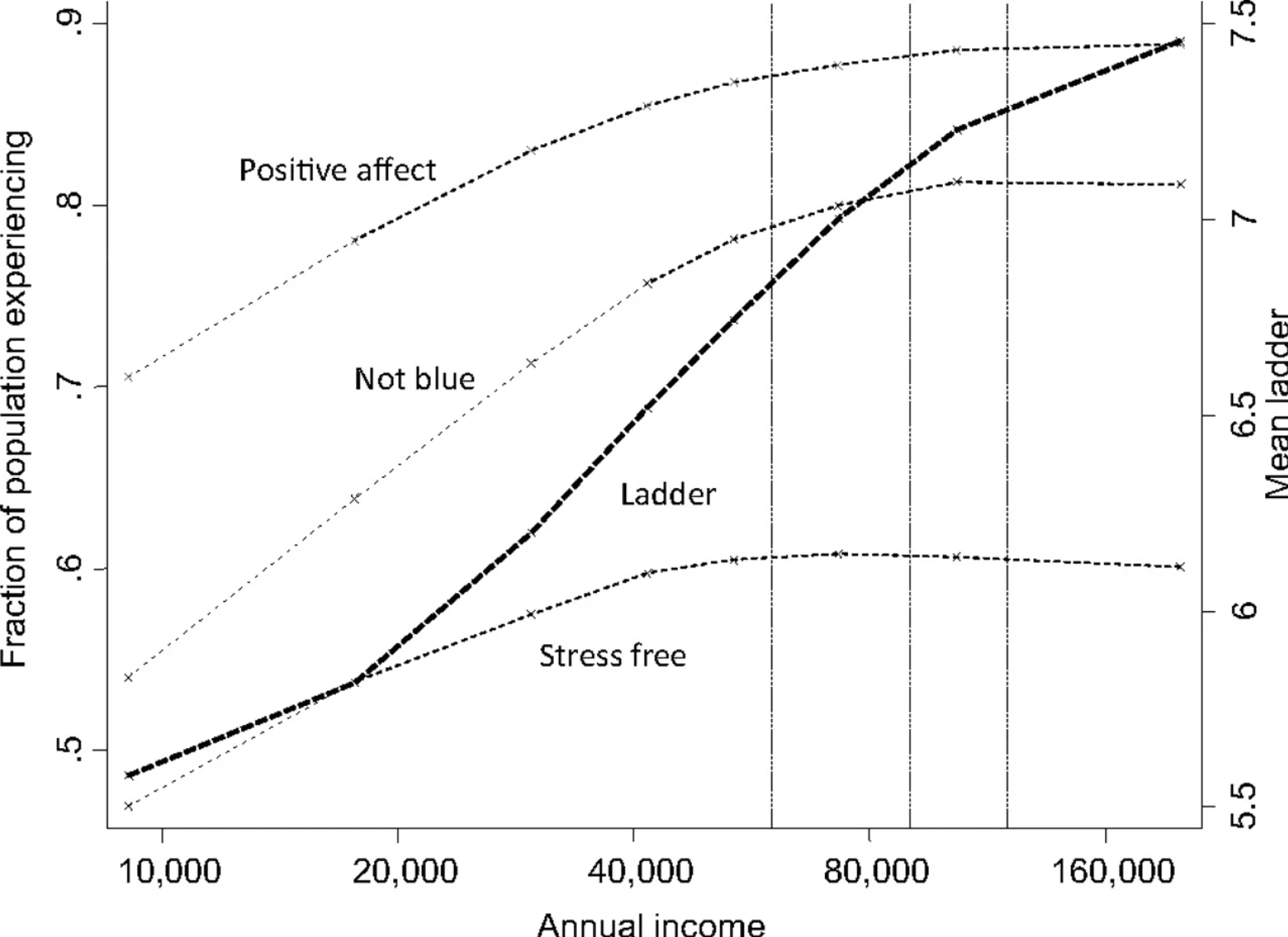
key takeaway from the graph: "extra income had no relationship with how happy, sad and stressed people felt after a point on the curve" (note: study was done in 2010 - so adjust for inflation but inference stays the same - human psychology hadn't changed)
but also not all studies found money to not have impact on happiness - in a different studies that spanned its research across varying countries - the money impact inflection point either diminished or just shifted forward (meaning poorer countries associate happiness with money more)
what do we learn from that research? you take the best opportunities to invest in your happiness first, so as you get more money, it becomes harder and harder to buy more happiness
best uses of money
in relation to the happiness curve
- buy time (delegation, convenience)
- experiences over possessions
- giving (strong psychological ROI) this applies strongly to my high-output, high-variance career.
general infered rules for pf from my research
- budgeting and cash reserves
- keep 3-6 months of expenses in liquid cash (savings + liquid mutual fund)
- as income grows, adjust savings rate before lifestyle expenses creep in
- housing rent / EMIs
- rent can take upto ≤30% of income (consider home EMIs within this bracket as well)
- NOTE: a house you live in is not an investment - so don't think that going with home loan EMIs is a better option compared to renting as a bias
- treat it as a lifestyle decision, not an investment, unless:
- you plan to stay ≥ 7 years
- EMI ≤ 25% of net income
- still invest aggressively
- career is geographically stable
- rent can take upto ≤30% of income (consider home EMIs within this bracket as well)
- debt priority framework
- kill high interest debt first (credit cards, loans etc)
- can ignore low interest debts if returns elsewhere are high sourced from this
- investing philosophy
- focus on passive > active
- index first mindset
- mental model: earning + building over stock picking
- invest aggressively until your income stream is mostly passive. - rich dad, poor dad
- dollar cost averaging (DCA)
- statistically lump sum wins most of the time
- DCA is fine, as it helps staying emotionally invested
- portfolio construction
- simplify portfolio, lower cost, periodic rebalancing, no tinkering
- can also have half yearly rebalancing but also look into mechanical threshold based rebalancing
- define target allocation: eg. equity: 70%, debt: 25%, gold: 5% - if there is a drift of ±5-10% then rebalance
- check twice a year, rebalance once a year (if needed), prefer absolute threshold deviance for early career
- think of equity indexes, debt funds, gold funds
- expense ratios on the funds matter more than we think (fee taken by the fund annually)
- be careful with recency bias
- geographic diversification
- single country portfolio is an actual risk to consider
- think global equities + emerging markets + some India tilt
- can think of this when income crosses 80K USD
- risk tolerance > optimization
- consistency beats cleverness
- gold
- gold is NOT a growth asset
- it's a hedge against systemic risk
- 5% direct gold allocation is reasonable
- anything beyond can be with ETFs, sovereign bonds
- can be extended based on cultural reasons (ornamentals)
- market timings
- boring, hated sectors often outperform hype.
- “next revolution” is often overpriced (ai, crypto, etc)
- income growth on year
- baseline stable income professional: 10–15% YoY - beats inflation and lifestyle creeps
- founder / high variance path:
- think in step functions
- flat or modest growth for couple years atleast
- 30-100% jumps when: equity crystallizes, consulting rates reset, a product starts paying, a role upgrade happens
- if you’re not seeing a meaningful income reset every ~24 months, something’s off
- don’t force a clean CAGR on a chaotic career. force shots on goal.
- buying a car
- a car is a pure consumption asset. buy it consiously
- hard constraints:
- total car cost ≤ 6–12 months of net income, if higher → lifestyle inflation
- down payment ≥ 30–40%; avoid heavy leverage on any depreciating asset
- loan tenure ≤ 4 years
- EMI ≤ 10–12% of net monthly income
- misc
- social proof is a dangerous drug (“everyone thinks housing only goes up.”)
References
- Nick Bradford's personal finance guide inspired me to go do my own research on the topic he had covered
- https://www.youtube.com/watch?v=Uwl3-jBNEd4
- The Big Short - movie
- JP Morgan Guide to the Markets (Real Assets section)
- Edmunds: True Cost of Ownership (TCO)
- SPIVA Reports (S&P Dow Jones Indices): Active vs Passive Scorecards
- Bogleheads Wiki: Investment Philosophy
- Investopedia
- Vanguard: The Cost Matters Hypothesis
- Swedroe & Balin: Reducing the Risk of Black Swans
- Daniel Kahneman: Thinking, Fast and Slow
- Morgan Housel: The Psychology of Money